
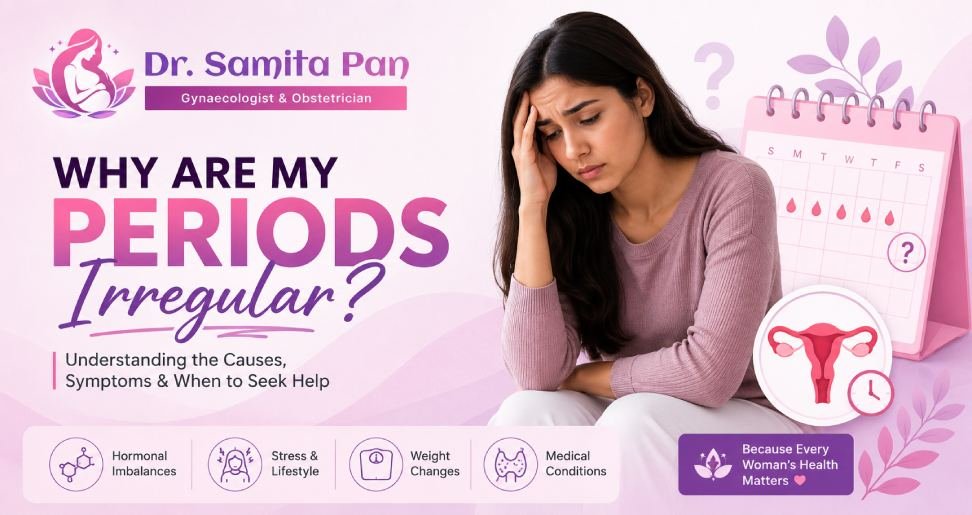
This is the question we get asked every single week”My periods are irregular. Is that normal?”
Sometimes yes but often no. The answer depends entirely on what irregular means in that specific patient’s case. And most women who ask us this question have been wondering for months, sometimes years, without a clear answer.
A cycle that shifts by three or four days each month is normal. A cycle that comes every 50 days, or disappears for four months, or shows up twice in six weeks is not something to wait out. It’s something to investigate.
We tell patients this upfront. Your cycle is not random. When it changes, something in your body has changed. Our job is to find out what.
What We Usually Find When We Investigate
No two patients are the same. But certain causes come up again and again.
PCOS is the most common thing we diagnose. The hormone imbalance in PCOS disrupts the whole ovulation cycle. Periods become irregular or stop entirely. We test for it routinely when patients come in with cycle changes.
Thyroid problems get missed more than they should. An underactive thyroid slows the whole body down, including the cycle. Periods become heavier and less frequent. An overactive thyroid can make them lighter and more unpredictable. We always check thyroid function because it’s a quick blood test and we find problems more often than patients expect.
Stress genuinely affects the cycle. Not slightly. Significantly. We see patients whose cycles were perfectly regular for ten years and became erratic after a difficult few months. Cortisol, the stress hormone, directly interferes with the hormones that drive ovulation.
Other Common Causes We Look For
The cycle often comes back once the stress settles. Sometimes it needs a push.
Weight changes matter too. Being significantly underweight shuts ovulation down. Weight gain around the belly raises insulin and androgen levels in ways that throw the cycle off. We see both patterns regularly.
Perimenopause starts earlier than most women think. We get patients in their late thirties convinced something is wrong when they’re actually in the early stages of perimenopause. It can start a full decade before menopause. Irregular cycles are one of the first signs and it’s consistently underdiagnosed in younger women.
Elevated prolactin is another because we check for. When prolactin is too high, ovulation gets suppressed. It’s less common than the others but easy to identify and treat once we know to look for it.
The 8 Types of Abnormal Periods We See in Clinic
We find naming the pattern helps patients understand what we’re investigating.
Oligomenorrhea: It means periods coming very infrequently, more than 35 days apart.
Polymenorrhea: It means too often, less than 21 days apart.
Amenorrhea: It is no periods at all for three months or more.
Menorrhagia: Itis very heavy bleeding.
Hypomenorrhea: It is very light bleeding.
Dysmenorrhea: It is periods that come with significant pain.
Metrorrhagia: Itis bleeding between periods at unexpected times.
Menometrorrhagia: It is the combination of heavy bleeding and irregular timing.
Each pattern points us toward different investigations. This is why telling us the pattern matters.
What Irregular Periods Do to the Body Over Time
We want patients to understand that irregular periods are not just inconvenient. They’re a sign the body is not doing something it should be doing.
Irregular ovulation makes natural conception harder to time. Long gaps between periods can cause the uterine lining to build up in ways that carry longer-term risk. When the cause is PCOS or a thyroid problem, the underlying condition is also affecting energy, weight, mood, and metabolic health in the background. Low oestrogen from missed cycles affects bone density over years.
The cycle is a health indicator when it’s consistently off, something is consistently off inside.
For Teenage Girls Specifically
Parents bring teenagers to us quite often and the first thing we do is reassure them.
In the first one to two years after periods begin, irregular cycles are completely expected. The hormonal system is still developing. This is not a problem worth worrying about.
What we do look at is irregularity that continues past the two-year mark, periods that are extremely painful, or periods that are very heavy. Those warrant investigation. PCOS is the most common thing we find in teenage girls with persistent irregular cycles. Thyroid issues are the second most common but both are very manageable.
We do not start medication for teenagers without a clear diagnosis first.
What Patients Can Do
Keep a cycle record. When periods start, how long they last, how heavy, what symptoms come with them. Three months of this gives us far more to work with than a patient trying to remember at the appointment.
Write down other changes too. Hair, skin, weight, energy, mood. These connect to the hormonal picture.
And if periods have been irregular for more than three months alongside pain, heavy bleeding, or other symptoms, don’t wait any longer better to consult doctor.
What Our Patients Ask
Ans :- Stress, thyroid changes, weight changes, and early perimenopause are the most common sudden causes. A blood test usually tells us within a week.
Ans :- Over time they affect fertility, bone density, and often signal an underlying condition affecting overall health. The longer the cause goes unaddressed, the more it impacts.
Ans :- We investigate first. PCOS and thyroid testing. Then we discuss lifestyle and targeted treatment based on what we find. We do not start medication without knowing what we’re treating.
The Right Time to Come In Is Now
Slightly irregular cycles with no other symptoms are usually not worrying.
Come and see us when periods have stopped for three months or more, when bleeding has become much heavier or more painful than before, when you’re trying to conceive and the cycle is getting in the way, or when the change in your cycle came alongside other changes in your body.
Dr. Samita Pan provides full hormonal assessment for irregular periods including PCOS and thyroid investigation, a clear diagnosis, and a treatment plan that addresses the actual cause. If your cycle has been off and you’ve been putting off finding out why, that appointment is worth making now.