
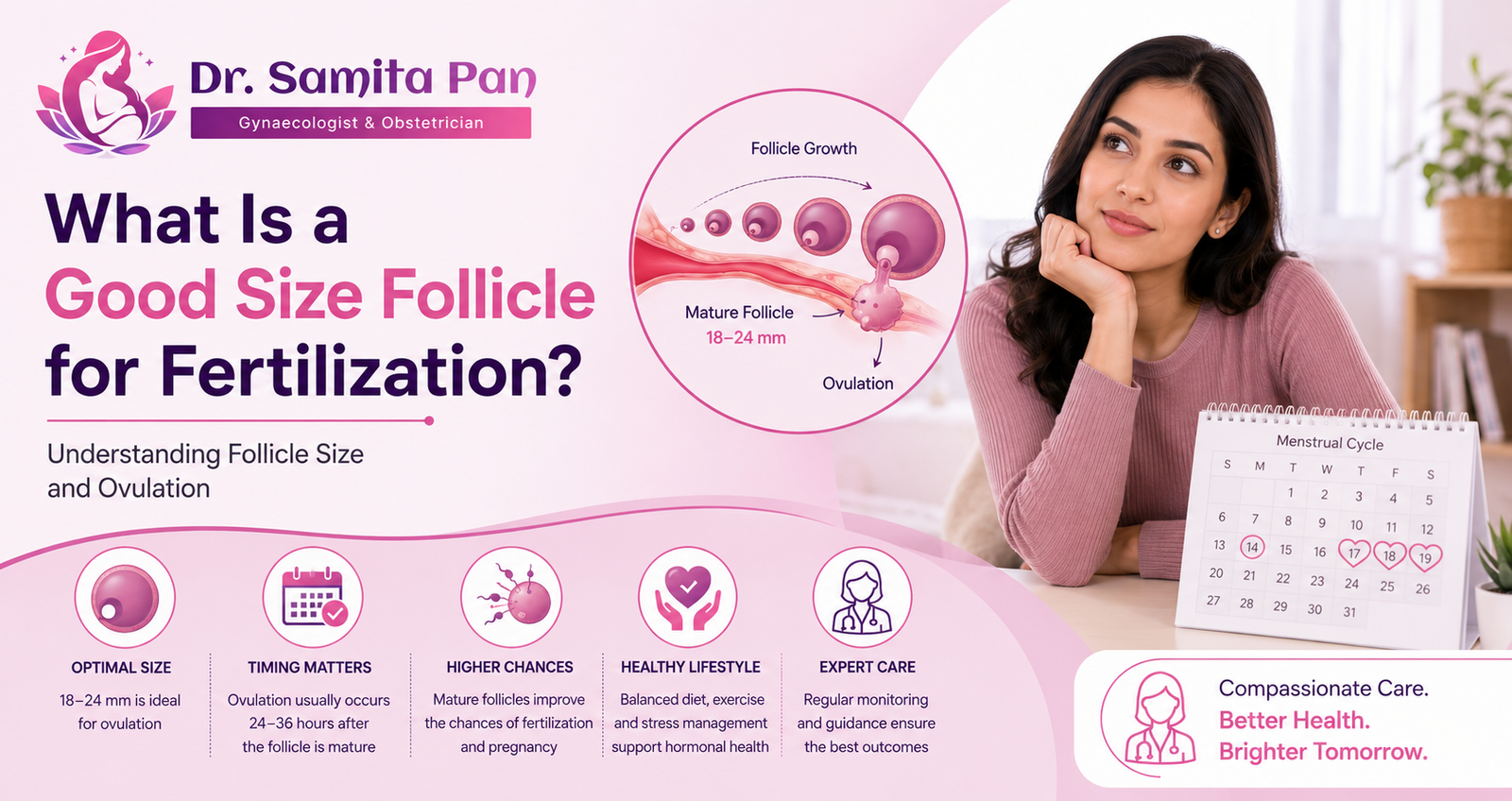
When trying to conceive, one of the most common questions women ask during follicular monitoring is: “What is a good size follicle for fertilization?” Follicle size is an important part of tracking ovulation because the follicle is where the egg develops before it is released from the ovary.
In general, a mature follicle is often around 18–24 mm before ovulation, although the ideal size can vary depending on the individual, the menstrual cycle, medications used and the fertility treatment being planned. Follicle size alone does not guarantee fertilization or pregnancy.
Understanding how follicles grow, when ovulation occurs and what doctors look for during ultrasound monitoring can make the fertility journey less confusing.
What Is a Follicle?
A follicle is a small fluid-filled structure inside the ovary that contains an immature egg. During each menstrual cycle, several follicles may begin developing, but usually one becomes the dominant follicle.
As the dominant follicle grows, the egg inside it matures. Around ovulation, the mature follicle releases the egg from the ovary. The released egg can then potentially be fertilized by sperm.
Doctors can monitor this process using transvaginal ultrasound, commonly called follicular monitoring or follicular study.
What Is a Good Size Follicle for Fertilization?
A dominant follicle measuring approximately 18–24 mm is generally considered mature around the time of ovulation.
However, there is no single follicle measurement that guarantees successful fertilization. Some women may ovulate with follicles outside this range, and the follicle’s growth pattern is also important.
Doctors may consider several factors, including:
- Follicle size
- Rate of follicular growth
- Endometrial thickness and appearance
- Hormonal levels when required
- Timing of ovulation
- Sperm health
- Age and ovarian reserve
- Whether conception is natural, through IUI or through IVF
Therefore, an ultrasound showing an 18 mm, 20 mm or 22 mm follicle does not by itself determine whether pregnancy will occur.
What Follicle Size Is Ideal for Ovulation?
Follicles generally grow gradually during the first part of the menstrual cycle. A dominant follicle may grow by roughly 1–2 mm per day, although growth rates differ among women.
When the follicle reaches maturity, ovulation may occur naturally or may be triggered during fertility treatment.
A follicle measuring around 18–24 mm is commonly associated with maturity, but your fertility specialist will interpret the measurement along with the rest of your cycle.
Is a 16 mm Follicle Mature?
A 16 mm follicle may still be developing. It could continue growing and become mature over the following days.
Your doctor may recommend another ultrasound to monitor its growth rather than assuming that ovulation has already occurred.
Is an 18 mm Follicle Good for Fertilization?
An 18 mm follicle can be considered close to or within the commonly accepted mature range. Depending on the cycle, ovulation may occur as the follicle continues developing.
However, successful fertilization depends on more than follicle size.
Is a 20 mm Follicle Good for Pregnancy?
Yes, a 20 mm follicle is generally considered a mature follicle size around ovulation. It may be suitable for natural conception or fertility treatment depending on the overall clinical situation.
Is a 24 mm Follicle Too Large?
Not necessarily. Follicles can sometimes grow beyond 24 mm before ovulation. A larger follicle does not automatically mean that the egg cannot be fertilized.
The doctor will assess whether ovulation has occurred, whether the follicle has ruptured and what the endometrium looks like.
How Does Follicular Monitoring Help?
Follicular monitoring allows a doctor to follow follicle development through ultrasound examinations performed at appropriate points in the menstrual cycle.
It can help determine:
- Which follicle is becoming dominant
- Whether the follicle is growing appropriately
- Approximately when ovulation may occur
- Whether the follicle has ruptured
- Whether the uterine lining appears suitable for conception
- The appropriate timing for intercourse, IUI or other fertility procedures
This is particularly useful for women undergoing ovulation-induction treatment or IUI.
What Happens After the Follicle Reaches the Right Size?
Once the follicle reaches an appropriate stage of maturity, ovulation may occur naturally. In some fertility treatments, a doctor may use an ovulation trigger injection to help time egg release.
For natural conception, couples may be advised to have intercourse around the fertile window.
For IUI, the procedure is carefully timed around ovulation to increase the chances of sperm being present when the egg is released.
The exact timing should always be determined by the treating fertility specialist.
Does Bigger Follicle Size Mean Better Chances of Pregnancy?
Not necessarily.
A common misconception is that a larger follicle automatically means a better-quality egg and higher chances of pregnancy. Follicle size mainly provides information about follicular development and likely ovulation timing.
Egg quality is influenced by several factors, including age and ovarian health. Sperm quality, the fallopian tubes, uterine health and timing of intercourse or treatment can also affect conception.
Therefore, fertility assessment should never be based on follicle size alone.
What About Endometrial Thickness?
During follicular monitoring, doctors may also examine the endometrium, or uterine lining.
A developing follicle and a receptive uterine lining are both important parts of the reproductive process. Estrogen produced during follicular development helps the endometrium thicken during the first half of the cycle.
Your doctor may therefore look at both follicle development and the endometrial appearance when assessing the fertile window.
When Should You Consult a Gynecologist?
Consider consulting a gynecologist if:
- Your periods are consistently irregular
- You are not detecting ovulation
- You have been trying to conceive without success
- Follicles are not developing as expected
- You have been advised to undergo follicular monitoring
- You are considering IUI or other fertility treatment
- You have PCOS or another condition affecting ovulation
A fertility evaluation can help identify whether the issue is related to ovulation or whether other factors may be affecting conception.
FAQs:
What is a good size follicle for fertilization?
A follicle of approximately 18–24 mm is commonly considered mature around ovulation. However, the ideal size can vary, and follicle size alone cannot guarantee fertilization.
Can a 17 mm follicle release an egg?
A 17 mm follicle may continue growing before ovulation. Whether and when it releases an egg depends on the individual cycle and hormonal changes.
What is the best follicle size for IUI?
Many IUI cycles are timed when a dominant follicle reaches a mature size, commonly around 18–24 mm, but the exact timing depends on the patient’s response to treatment and the doctor’s assessment.
How fast does a follicle grow?
A dominant follicle may grow approximately 1–2 mm per day during the later part of follicular development, although growth varies between individuals and cycles.
Does follicle size guarantee pregnancy?
No. A mature follicle indicates that ovulation may be approaching, but pregnancy also depends on egg and sperm factors, fallopian tube function, uterine conditions, timing and several other factors.
Conclusion
So, what is a good size follicle for fertilization? In many cases, a follicle measuring approximately 18–24 mm is considered mature around ovulation. But fertility is more complex than reaching a particular follicle size.
Regular follicular monitoring can help your gynecologist understand follicle development, predict ovulation and determine the appropriate timing for conception or fertility treatment. If you are concerned about follicle growth or trying to conceive, personalized medical advice is more useful than comparing your ultrasound measurement with someone else’s.
Consult Dr. Samita Pan, Gynecologist Near Phoolbagan, Kolkata
If you are tracking ovulation, undergoing follicular monitoring or having difficulty conceiving, consult Dr. Samita Pan, Gynecologist near Phoolbagan, Kolkata, for personalized fertility evaluation and guidance.
Whether you are trying naturally or considering fertility support such as IUI, getting the right assessment at the right time can help you understand your reproductive health better.
Book a consultation with Dr. Samita Pan and take an informed step toward your pregnancy journey.
Read More: