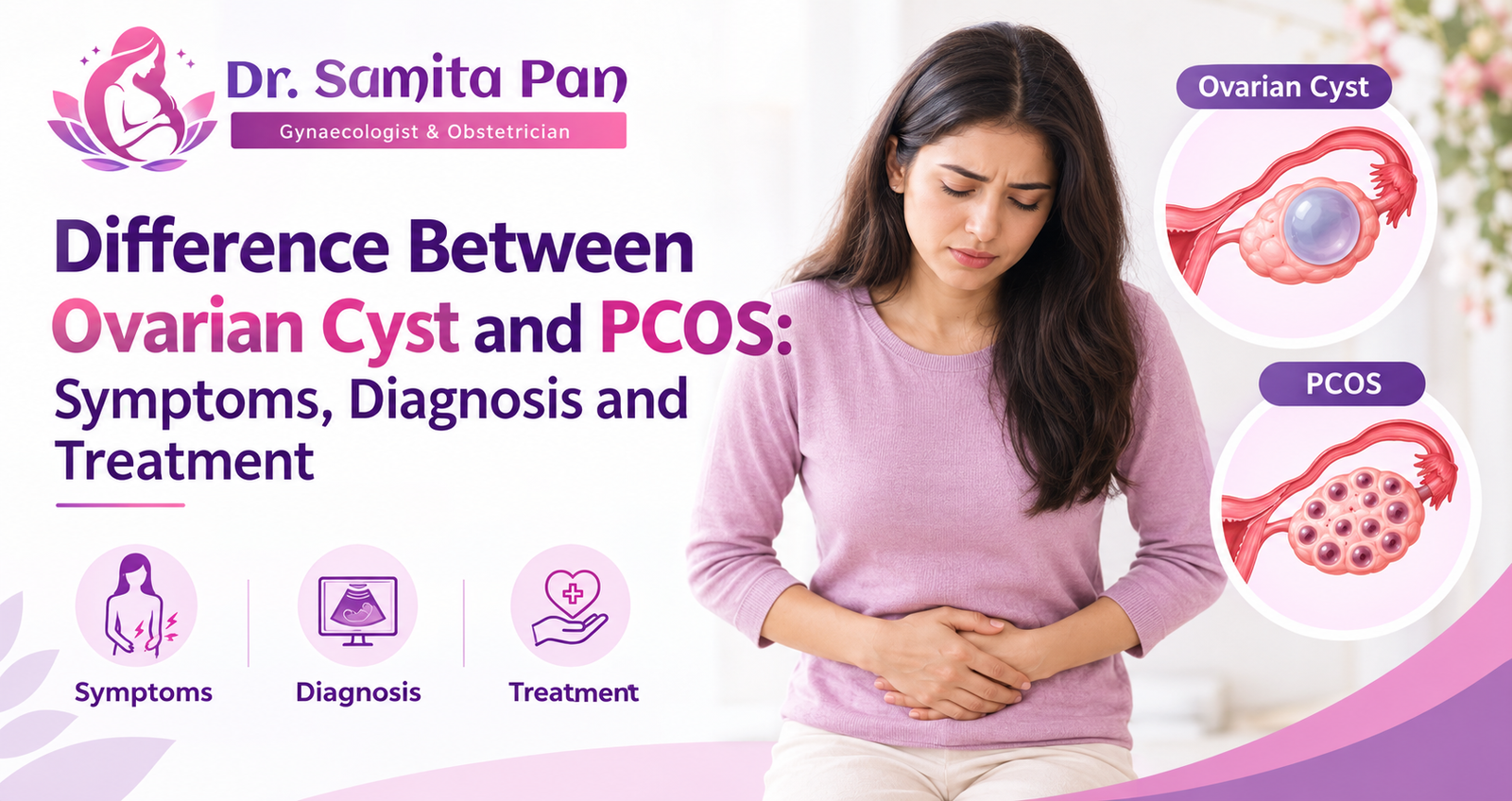
Women often search for the difference between ovarian cyst and PCOS after experiencing irregular periods, pelvic discomfort, hormonal changes or fertility concerns. Because both conditions involve the ovaries, they are sometimes confused with one another. However, an ovarian cyst and polycystic ovary syndrome (PCOS) are not the same condition.
An ovarian cyst is usually a fluid-filled sac that develops in or around an ovary, while PCOS is a hormonal condition that can affect ovulation, menstrual cycles and androgen levels. Knowing the difference can help women understand their symptoms and seek appropriate gynaecological care.
What Is an Ovarian Cyst?
An ovarian cyst is a sac containing fluid or other material that develops on or inside an ovary. Cysts are relatively common during the reproductive years, and many are associated with the normal menstrual cycle.
Some ovarian cysts may not cause any symptoms and can disappear naturally. Others may become larger or cause discomfort. Depending on the type and size of the cyst, symptoms can include pelvic pain, abdominal heaviness, bloating, painful intercourse or changes in menstruation.
In some cases, a cyst may rupture or cause the ovary to twist. Sudden, intense pelvic pain, particularly when accompanied by nausea or vomiting, requires prompt medical evaluation.
What Is PCOS?
Polycystic ovary syndrome, commonly called PCOS, is a hormonal and metabolic condition that can affect women during their reproductive years. It may interfere with regular ovulation and cause changes in menstrual cycles and androgen levels.
Common signs of PCOS include:
- Irregular or missed periods
- Difficulty with ovulation
- Acne or oily skin
- Increased facial or body hair
- Thinning scalp hair
- Difficulty becoming pregnant
- Weight gain or difficulty managing weight in some women
PCOS varies from person to person, so not every woman will experience the same combination of symptoms.
Difference Between Ovarian Cyst and PCOS
The simplest way to understand the difference is to look at what each condition represents.
An ovarian cyst is a physical structure that develops in or around an ovary. It may occur as part of the menstrual cycle or because of another underlying condition.
PCOS is a hormonal syndrome involving ovulation and androgen-related changes. Despite the word “polycystic,” PCOS does not simply mean that the ovaries contain conventional cysts.
Women with PCOS may have multiple small follicles visible on an ultrasound. These follicles are different from the larger ovarian cysts that may require monitoring or treatment.
Therefore, having an ovarian cyst does not automatically mean that you have PCOS, and having PCOS does not necessarily mean that you have an ovarian cyst.
Ovarian Cyst vs PCOS: Symptoms
Although symptoms can overlap, there are some useful differences.
Symptoms commonly associated with ovarian cysts
- Pelvic or lower abdominal pain
- Abdominal pressure or fullness
- Bloating
- Pain during intercourse
- Changes in menstrual bleeding
- Symptoms caused by a large or ruptured cyst
Symptoms commonly associated with PCOS
- Irregular or absent periods
- Infrequent ovulation
- Acne
- Excess facial or body hair
- Scalp hair thinning
- Difficulty conceiving
Because several other gynaecological or hormonal conditions can cause similar symptoms, symptoms alone cannot confirm either diagnosis.
Why Does PCOS Have “Cysts” in Its Name?
This is one of the most common points of confusion.
In PCOS, the ovaries can contain numerous small follicles that may appear on an ultrasound as a polycystic ovarian pattern. These are not necessarily the same as pathological ovarian cysts.
A follicle is a structure in the ovary where an egg develops. In PCOS, hormonal changes can interfere with normal follicle development and ovulation. As a result, multiple small follicles may be visible.
This is why an ultrasound showing multiple follicles should not automatically be interpreted as proof of PCOS. A gynaecologist considers the ultrasound findings alongside menstrual history, symptoms and relevant investigations.
How Are Ovarian Cysts Diagnosed?
A doctor may suspect an ovarian cyst based on symptoms and physical examination. An ultrasound is commonly used to examine the ovaries and understand the cyst’s size and appearance.
Depending on the findings, the doctor may recommend observation and follow-up imaging. Many functional cysts resolve without treatment.
Treatment depends on factors such as the cyst’s characteristics, symptoms, persistence, age and reproductive circumstances. Some cysts may require medicines or surgery when they are persistent, large, painful or have concerning features.
How is PCOS Diagnosed?
There is no single test that confirms PCOS in every patient. Diagnosis generally involves assessing menstrual patterns, symptoms, signs of androgen excess and appropriate blood tests. An ultrasound may also be used when required.
Doctors also consider other possible causes of irregular periods or hormonal symptoms before making a diagnosis.
This is important because irregular periods alone do not necessarily mean PCOS. Similarly, an ultrasound appearance alone may not be enough to establish the condition.
Can Ovarian Cysts Affect Fertility?
Most ovarian cysts do not automatically cause infertility. However, certain types of cysts or the underlying condition responsible for them may affect reproductive health.
For example, some ovarian conditions associated with endometriosis can be linked with fertility difficulties. The effect depends on the type of cyst and the individual’s overall reproductive health.
Can PCOS Affect Pregnancy?
PCOS can make conception more challenging for some women because irregular ovulation can reduce the frequency of egg release.
However, having PCOS does not mean that pregnancy is impossible. A gynaecologist can evaluate ovulation, menstrual patterns and other fertility factors and recommend appropriate management based on pregnancy plans.
Ovarian Cyst and PCOS: Are They Treated the Same Way?
No. Their management is different because they have different underlying causes.
A small, uncomplicated ovarian cyst may simply require observation. Treatment becomes more important when a cyst causes significant symptoms, persists, grows or has concerning characteristics.
PCOS generally requires ongoing management based on the woman’s symptoms and goals. Treatment may involve menstrual-cycle management, addressing androgen-related symptoms, supporting ovulation when pregnancy is desired and managing associated metabolic concerns.
When Should You Consult a Gynaecologist?
Consider speaking with a gynaecologist if you experience:
- Repeatedly irregular or missed periods
- Persistent pelvic pain
- Unexplained bloating or abdominal discomfort
- Excess facial or body hair
- Persistent acne with menstrual irregularities
- Difficulty becoming pregnant
- An ovarian cyst detected during an ultrasound
Sudden severe pelvic pain, especially with nausea or vomiting, should receive urgent medical attention.
FAQs:
1. Is an ovarian cyst the same as PCOS?
No. An ovarian cyst is generally a fluid-filled sac or other structure in or around an ovary, while PCOS is a hormonal syndrome that can affect ovulation and menstrual cycles.
2. Can you have an ovarian cyst without having PCOS?
Yes. Ovarian cysts can occur in women who do not have PCOS and may develop as part of the normal menstrual cycle.
3. Does PCOS mean I have ovarian cysts?
Not necessarily. PCOS may produce a polycystic appearance of the ovaries, but the small follicles seen in PCOS are not the same as typical ovarian cysts.
4. Which is more likely to cause irregular periods: ovarian cyst or PCOS?
Both can sometimes be associated with menstrual changes. However, irregular ovulation and periods are common features of PCOS. The underlying cause should be evaluated by a gynaecologist.
5. Can PCOS and ovarian cysts occur together?
Yes. A woman with PCOS can also develop an ovarian cyst, because having PCOS does not prevent other ovarian conditions from occurring.
6. Can ovarian cysts affect pregnancy?
Most ovarian cysts do not prevent pregnancy. However, certain types of cysts or underlying reproductive conditions may affect fertility and should be evaluated individually.
7. Can PCOS be treated?
PCOS can be managed with an individualised treatment plan. Management depends on symptoms, menstrual health, metabolic factors and whether pregnancy is currently desired.
8. Should I see a doctor if an ultrasound shows multiple ovarian follicles?
Yes, particularly if you also have irregular periods, acne, excess hair growth or fertility concerns. An ultrasound finding should be interpreted alongside your symptoms and medical history.
Consult a Gynaecologist in Phoolbagan, Kolkata
Confused about whether your symptoms may be related to an ovarian cyst, PCOS or another gynaecological condition? Professional evaluation can help identify the underlying cause instead of relying on symptoms or an ultrasound report alone.
Consult Dr. Samita Pan, Gynaecologist in Phoolbagan, Kolkata, for personalised evaluation and guidance regarding menstrual irregularities, PCOS, ovarian cysts, fertility concerns and women’s reproductive health.
Your Women’s Health Deserves Personalised Care
If you are experiencing irregular periods, pelvic discomfort, hormonal symptoms or concerns about conception, take the next step towards understanding your reproductive health.
Book a consultation with Dr. Samita Pan, Gynaecologist in Phoolbagan, Kolkata, and discuss your concerns with a qualified women’s health specialist.
Read More: